

Natalie Braido
- ART & SCIENCE
*1996 in São Paulo, Brazil. Lives and works in São Paulo.
Residency period: September to December 2026
Visual artist
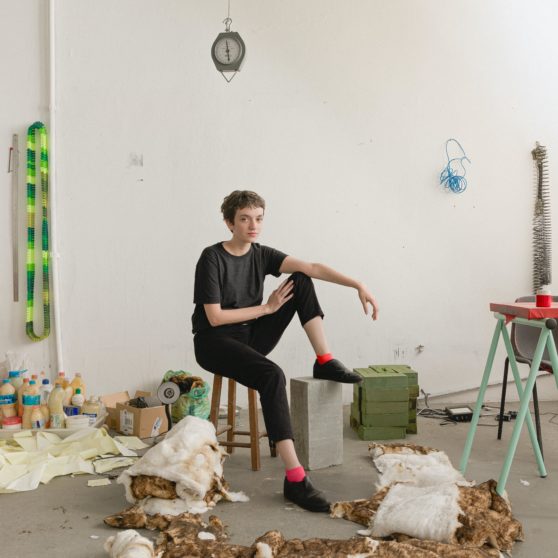
Natalie Braido is a Brazilian visual artist whose sculptures and installations investigate time, impermanence, and the unstable behaviour of matter. Using ephemeral materials, everyday technologies, and mechanisms (including water, salt, ice, heat, condensation, electricity, and responsive alloys) she creates systems that transform in real time, moving between control and failure, visibility and latency.
She holds bachelor’s and teaching degrees in Visual Arts from São Paulo State University (UNESP, 2019). Earlier presentations include exhibitions at A Gentil Carioca (2019) and Museu da Inconfidência (2024). Recent projects include the solo exhibition Diagrama de Fases at Marli Matsumoto, the two-person exhibition Dois with Marcius Galan, and a residency at Pivô Salvador, all in 2025. In 2026, her work was included in exhibitions at Luisa Strina, Superfície, and the Moraes-Barbosa Collection. She has been selected for a Pro Helvetia residency in Switzerland in 2027.
During her residency, Natalie Braido will work in dialogue with the Laboratory for Bio-Iontronics (BION) at EPFL. Her practice investigates systems that behave rather than simply exist, bringing together water, salt, osmosis, and condensation with electrical and mechanical systems through which energy produces movement, discharge, and material change. These works move between two forms of transformation: processes also present in living systems and processes driven by energy, particularly electricity.
BION offers a context in which these two areas meet: its droplet-based iontronic systems use the movement of ions through soft, aqueous interfaces to generate energy, transmit signals, respond to stimuli, and interact with biological systems. During the residency, Braido will investigate how these different forms of transformation can coexist within the same artistic system, mapping correspondences and frictions between laboratory processes and her practice. The research will be developed through material and sculptural experiments and documented in a visual essay bringing together images, diagrams, and questions emerging from the collaboration.
Year